Industry Insights
Smart Film for Hotel Bathrooms: Privacy & Design Guide
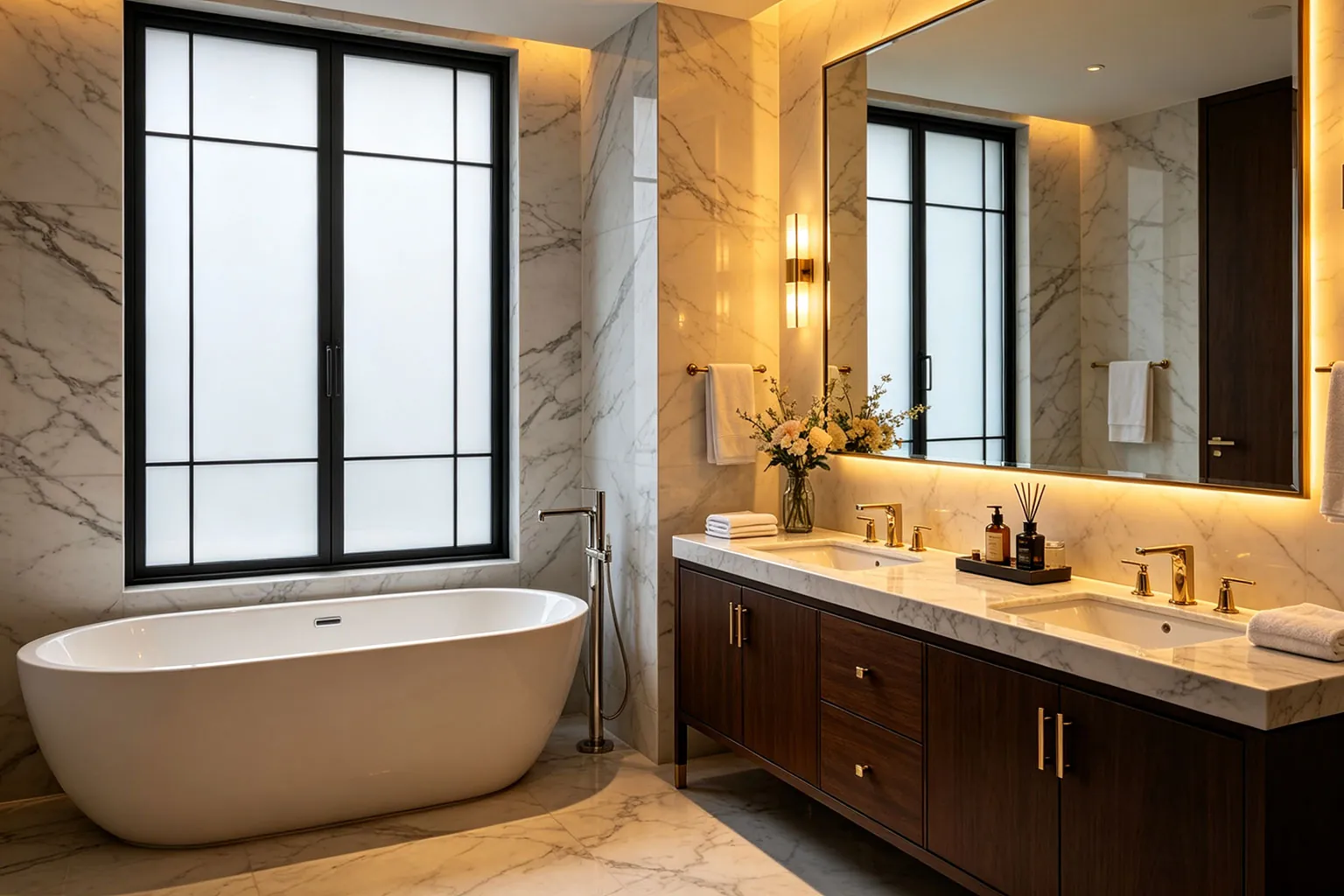
The hotel bathroom has evolved from a purely functional space to a key differentiator in guest experience. Modern travelers expect bathrooms that feel spacious, luxurious and private — a challenge when bathrooms are often small, windowless, or separated by glass walls that either block light or compromise privacy. PDLC smart film solves this elegantly: glass walls that are transparent when you want light and views, frosted when you need privacy. This guide explains why smart film is becoming a standard feature in boutique and luxury hotels, and how to specify it correctly.
Why Hotels Are Adopting Smart Film
Hotel operators choose PDLC smart film for bathroom glass for several compelling reasons:
- Space perception: transparent glass makes small bathrooms feel larger and connected to the room
- Natural light: glass walls let daylight reach interior bathrooms, reducing daytime lighting needs
- Instant privacy: one touch on a wall switch or bedside control turns the glass frosted
- Luxury impression: smart technology signals a premium, modern hotel experience
- Design flexibility: glass replaces solid walls, opening up floor plan options
- Energy savings: daylight reduces artificial lighting; frosted state provides insulation
- Maintenance: glass is easier to clean than curtains or blinds that collect moisture and mold
Typical Hotel Applications
- Bathroom-to-bedroom glass partitions: the most common application — switch between open feel and privacy
- Shower enclosures: frosted for privacy during use, transparent to showcase designer tilework
- Toilet compartment glass: instant privacy at the touch of a button
- Spa and wellness areas: switch between social (transparent) and private (frosted) modes
- Suite connecting doors: glass doors that become opaque for privacy between rooms
- Meeting and event spaces: glass walls that switch for breakout sessions
Product Specification for Hotel Bathrooms
Hotel bathrooms are humid environments, so product selection is critical. Here are our recommendations:
- Product type: Laminated switchable glass (preferred) or self-adhesive film with full edge sealing
- Glass: 8-10mm tempered, laminated for safety (required for shower enclosures in most codes)
- Film grade: Standard white (haze ≥95% for complete privacy, transmittance ≥80% when clear)
- Voltage: 48–65V AC (nominal 60V, safe for wet environments, low risk of electrical hazard)
- IP rating: Transformer and controls must be IP44+ for bathroom installation
- Control: Wall switch inside bathroom + secondary control at bedside (convenience)
- Edge sealing: 100% silicone sealant on all edges, especially bottom edge near water
Control System Design for Hotels
Hotel smart film control should be intuitive for guests while manageable for staff. Best practices:
- Primary wall switch: inside bathroom, clearly labeled 'Privacy Glass' with LED indicator
- Bedside secondary switch: allows guests to frost the bathroom glass from bed
- Master override: housekeeping staff can reset all glass to transparent for cleaning
- Room card integration: glass defaults to frosted when room is vacant (energy saving + privacy)
- Do Not Disturb sync: optional integration with DND indicator light
- No app required: physical switches are more reliable and guest-friendly than smartphone apps
For luxury suites, add a dimming controller that allows stepless opacity adjustment from 0-100%.
Installation Considerations
Hotel bathroom installations require attention to moisture and electrical safety:
- Electrical: all wiring must be in conduit, transformer in a dry, ventilated location outside the wet zone
- Sealing: apply neutral-cure silicone to all four edges after installation; pay special attention to the bottom edge
- Ventilation: ensure bathroom has proper exhaust fan to reduce humidity (target <70% RH)
- Glass type: use tempered laminated glass for shower enclosures (safety code requirement in most countries)
- Access: leave a service panel near the transformer for maintenance
- Timing: install film after all tiling and painting is complete to avoid construction damage
ROI Analysis for Hotel Owners
Smart film is an investment that can improve both guest satisfaction and operational efficiency:
- Cost per room: $800-2,500 for a typical bathroom partition (material + installation)
- Perceived value: guests perceive smart film as a premium feature, supporting higher room rates
- Review impact: 'smart glass bathroom' is a memorable feature mentioned in positive reviews
- Energy savings: daylight reduces lighting energy by 20-40% in rooms with glass bathrooms
- Maintenance: eliminates shower curtains (mold, replacement) and reduces blind cleaning
- Differentiation: stands out vs. competitor hotels in online booking comparisons
- Payback period: typically 2-4 years through higher ADR (average daily rate) and occupancy
Case Study: Boutique Hotel Renovation
A 48-room boutique hotel in Southeast Asia recently renovated all bathrooms with PDLC smart film partitions. Results after 6 months:
- Average daily rate increased by $15 (8% uplift) attributed to 'smart glass bathroom' feature
- Occupancy rate improved from 72% to 81% (feature listed as deciding factor in booking surveys)
- Guest satisfaction score (NPS) increased from 42 to 68
- Housekeeping time per room reduced by 3 minutes (no curtains to adjust/clean)
- Energy consumption for bathroom lighting reduced by 28%
- ROI achieved in 2.8 years
Common Mistakes to Avoid
- Using self-adhesive film without proper edge sealing in showers — leads to delamination
- Installing transformer inside the wet zone — electrical safety hazard
- Only one switch location — guests want control from both bathroom and bedside
- Skipping tempered glass for shower enclosures — safety code violation
- Poor ventilation — high humidity accelerates any film degradation
- Choosing cheap film without certification — yellowing and failure in 2-3 years
- No master override for housekeeping — staff cannot clean efficiently
Conclusion
PDLC smart film is a transformative feature for hotel bathrooms, combining the openness of glass with instant privacy at the touch of a button. It elevates guest experience, supports higher room rates, reduces maintenance, and saves energy — with a typical ROI of 2-4 years. The key to success is correct product specification (laminated glass for wet areas), proper edge sealing, and intuitive dual-control placement. AYSENT SMART FILM supplies hotel-grade switchable glass and film worldwide, with project references across boutique and luxury hotel properties. Contact us for a tailored quotation and design consultation for your hotel renovation or new build.
Frequently Asked Questions
Source Smart Film Directly from the Factory
AYSENT SMART FILM manufactures PDLC smart film, self-adhesive switchable privacy film and laminated smart glass in-house — with low MOQ, free samples, OEM/ODM customization and worldwide shipping.