Industry Insights
Switchable Glass as Projection Screen: Complete Guide
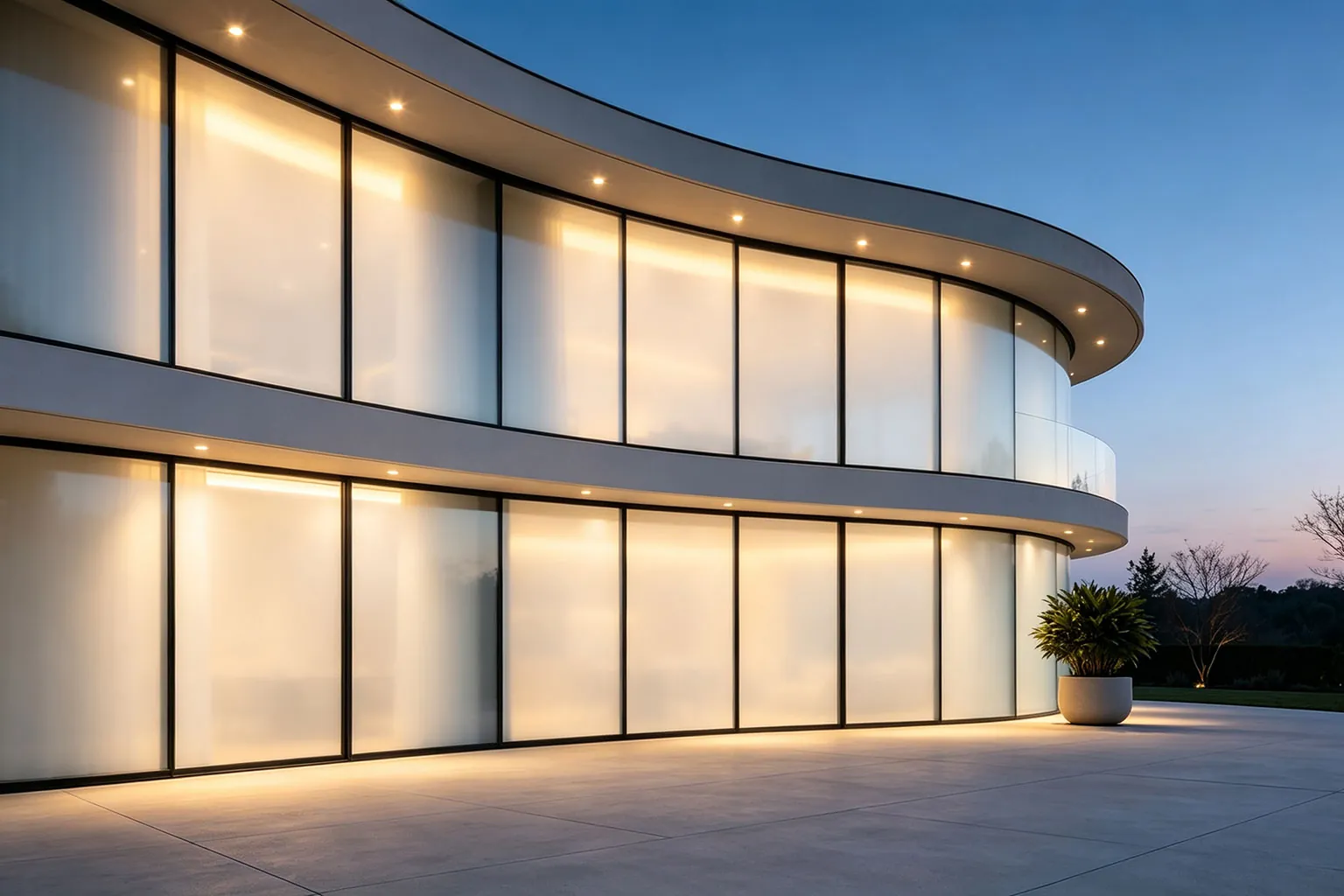
One of the most exciting features of PDLC smart film is its ability to double as a high-quality projection screen. In the frosted (OFF) state, the film's milky white surface is perfectly suited for rear projection — turning an ordinary glass wall into a giant display for presentations, advertising, or immersive experiences. This complete guide explains how it works, what equipment you need, and how to get the best results.
How Switchable Glass Projection Works
When PDLC film is in the OFF (frosted) state, liquid crystal droplets scatter light in all directions. This scattering property is exactly what makes a good projection screen: the frosted surface diffuses projected light evenly, creating a bright, viewable image from wide angles.
Rear projection is the standard setup: the projector is placed behind the glass, shining through the film toward the audience. This hides the projector and cabling, creates a clean look, and eliminates shadow interference from people walking in front of the screen.
The same glass can switch between transparent (normal window/partition) and frosted (projection screen) in 0.1 seconds, making it a dual-purpose surface that saves space and adds versatility.
Image Quality: What to Expect
PDLC film projection quality is excellent for presentations, advertising and ambient displays. Here are the key performance characteristics:
- Brightness: 80-90% of light passes through (gain ~0.8-0.9) — suitable for dim to medium ambient light
- Resolution: supports 1080p and 4K content; fine text is readable at normal viewing distances
- Viewing angle: ~160° horizontal and vertical — wider than most traditional screens
- Color: accurate color reproduction with good contrast in controlled lighting
- Uniformity: even illumination across the surface with a properly positioned projector
For critical applications (broadcast, medical imaging), a dedicated projection screen may still be preferable. For business presentations and digital signage, PDLC glass excels.
Projector Specifications
Choosing the right projector is critical for good results on PDLC glass. Here are our recommendations:
- Brightness: 3,000+ ANSI lumens for standard rooms; 5,000+ for bright environments
- Throw ratio: short-throw (0.4-0.8:1) for limited space behind glass; standard (1.5-2.5:1) for larger rooms
- Resolution: 1080p minimum; 4K for fine detail and large screens (above 100 inches)
- Laser vs. lamp: laser projectors preferred for 24/7 use (20,000+ hour lifespan, no lamp replacement)
- Keystone correction: essential for off-axis projector placement
Installation Best Practices
Proper installation ensures the best projection quality. Follow these guidelines:
- Projector distance: follow the manufacturer's throw ratio chart for your screen size
- Center alignment: position the projector lens at the vertical and horizontal center of the glass
- Ambient light: reduce direct sunlight on the viewing side; use blinds or shades if needed
- Backside enclosure: hide the projector in a cabinet, ceiling cavity or dedicated projection room
- Ventilation: ensure projector has adequate airflow (laser projectors generate less heat)
- Cable management: run HDMI and power cables in the wall or ceiling cavity
- Screen size: maximum seamless panel is 1,800mm wide (2,100mm ultra-wide available); larger screens use invisible seaming
Creative Applications
Switchable glass projection opens up creative possibilities that traditional screens cannot match:
- Meeting rooms: glass wall becomes a presentation screen, then switches back to transparent partition
- Retail storefronts: display advertising after hours, transparent during business hours
- Hotel lobbies: immersive welcome videos on feature walls
- Museums and exhibitions: interactive displays that reveal artifacts behind the glass
- Restaurants and bars: dynamic menu boards and ambiance projections
- Trade show booths: eye-catching displays that switch between video and product showcase
- Home theaters: movie screen that disappears when not in use
Cost Considerations
Using PDLC glass as a projection screen adds no extra cost beyond the standard smart film installation — the projection capability is inherent to the frosted state. Your total investment includes:
- PDLC film or switchable glass: $50-200/m² depending on grade and size
- Projector: $500 (1080p entry) to $5,000+ (4K laser professional)
- Installation: $1,000-5,000 depending on complexity
- Total for a 100-inch diagonal screen: $2,500-10,000+
Compared to a dedicated commercial projection screen ($1,000-3,000 for 100-inch), PDLC glass offers dual functionality at a competitive total cost.
Troubleshooting Common Issues
- Dim image: increase projector brightness, reduce ambient light, or use a higher-gain film
- Hotspot (bright center): move projector farther from glass or use a diffuse-enhancement film
- Color shift: calibrate projector color temperature to 6500K; warm up projector for 15 minutes
- Visible seam: for multi-panel screens, use the manufacturer's invisible seaming technique
- Image distortion: correct keystone and ensure projector is perfectly perpendicular to glass
Conclusion
PDLC switchable glass as a projection screen is a versatile, space-saving solution that combines privacy glass with display functionality. With the right projector and proper installation, it delivers excellent image quality for presentations, advertising and creative displays. The dual-purpose nature — transparent window one moment, projection screen the next — makes it uniquely valuable for offices, retail, hospitality and public spaces. AYSENT SMART FILM supplies projection-optimized PDLC film and can recommend compatible projectors for your specific application.
Frequently Asked Questions
Source Smart Film Directly from the Factory
AYSENT SMART FILM manufactures PDLC smart film, self-adhesive switchable privacy film and laminated smart glass in-house — with low MOQ, free samples, OEM/ODM customization and worldwide shipping.